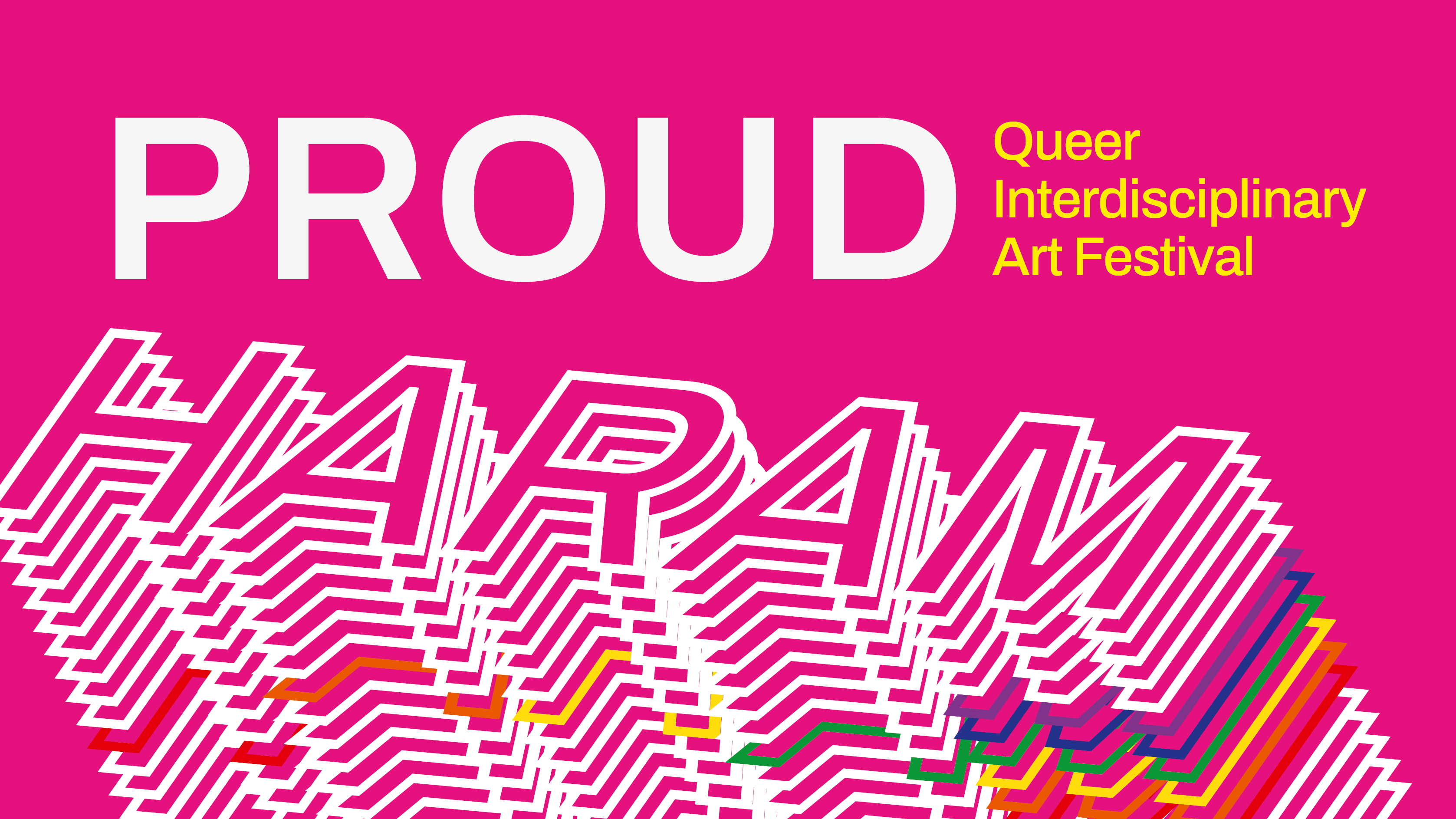
Proud Haram Festival
queer interdisciplinary art festival
Proud Haram Festival is a queer interdisciplinary art festival that provides a stage for LGBTQIA+ and migrant artists. Hosted at Ballhaus Prinzenallee from 11th -14th of June , it will feature theatre, performance, dance, music, and installations.
___
Statement of curator: Ufuk Tan Altunkaya
Welcome to the third year of the Proud Haram Festival. This year, I am taking on the festival’s artistic direction and curatorship for the second time—with pride, but also with a sense of responsibility.
I say responsibility because the name of this festival begins with a question that we must confront honestly. The word haram is not an ornament. For millions of people, it carries a deeply lived, layered, and vital meaning. Turning it from the outside into a tool of provocation—even with the best intentions—reveals an old reflex that we unconsciously repeat: the reflex of assuming the right to name what is taboo within someone else’s world. Understanding where this reflex comes from, what historical sense of authority sustains it, and how it continues to operate today is, for me, one of the most fundamental questions of this festival.
Since the end of the Cold War, the West has positioned itself as the sole legitimate bearer of Enlightenment values. The Middle East has been cast as a threat, a project, a case to be managed. This framework reproduces itself not only in politics, but also on stages, in funding applications, and in well-intentioned festival programs. I, too, am part of this machine. I do not hide that. Speaking from within is more uncomfortable—because it makes complicity visible.
Every year, dozens of queer events take place in Berlin. That is an achievement, certainly. But I also see that part of the struggle has lost its way. The energy that once pushed boundaries is sometimes transformed into a pursuit of recognition, a performance of visibility, an ambition to secure a seat at the table. The distance between the demand for equality and the pursuit of privilege can become dangerously narrow. I say this not as an external criticism, but as a discomfort that comes from within the movement itself.
And there is a question that will not leave me: Can those who speak most loudly today in the name of freedom and human rights truly look upon suffering in different parts of the world with the same sensitivity? It is an uncomfortable question, I know. But to step onto a stage without asking uncomfortable questions is also to overlook something.
In parts of Turkey, in Iran, and in many regions of the world, the price of queer existence is still paid with the body. We want to be in solidarity—this desire is genuine. But we must stop pretending that we experience the same reality. Making something visible on stage is not the same as truly standing beside someone. And sometimes the most honest position is to acknowledge precisely that difference.
Identity politics carries a similar paradox. In order to make people visible, it names them—and that was necessary; I understand that. But every act of naming also builds a cage. What truly matters is that one day this cage becomes unnecessary. What are we doing to make that happen—or are we merely decorating the cage?
Here in Berlin, as an artist of Middle Eastern heritage, I continue to ask myself: For whom am I creating? For whom do I stand on stage? Can this encounter become the ground for genuine transformation, or does everything ultimately remain exactly where it was? Is it always the same side that is expected to transform? I do not know the answers to these questions. But I want to make this festival precisely within that uncertainty, without closing these questions down.
>>DE
Das Proud Haram Festival ist ein interdisziplinäres Queer-Kunstfestival, das LGBTQIA+ und migrantischen Künstlerinnen eine Bühne bietet. Es findet vom 11 - 14. Juni im Ballhaus Prinzenallee statt und präsentiert Theater, Performance, Tanz, Musik und Installationen.
____
Statement des Kurators: Ufuk Tan Altunkaya
Willkommen zum dritten Jahr des Proud Haram Festivals. In diesem Jahr trage ich zum zweiten Mal die künstlerische Gesamtleitung und Kuratierung des Festivals – mit Stolz und mit Verantwortung zugleich.
Ich sage Verantwortung, weil mit dem Namen dieses Festivals eine Frage beginnt, der wir uns ehrlich stellen müssen. Das Wort Haram ist kein Schmuck, sondern trägt für Millionen Menschen eine von innen gelebte, vielschichtige, lebendige Bedeutung. Es von außen in ein Mittel der Provokation zu verwandeln – wie gut gemeint auch immer – bringt einen alten Reflex ans Licht, den wir unbewusst wiederholen: den Reflex, sich das Recht zuzusprechen, das zu benennen, was innerhalb einer anderen Welt ein Tabu ist. Zu verstehen, woher dieser Reflex kommt, von welchem historischen Selbstbewusstsein er sich nährt und wie er bis heute wirkt, gehört für mich zu den grundlegendsten Fragen dieses Festivals.
Seit dem Ende des Kalten Krieges hat sich der Westen als einzig legitimer Träger der Aufklärung positioniert. Der Nahe Osten wurde zur Bedrohung, zum Projekt, zum Fall. Dieser Rahmen reproduziert sich nicht nur in der Politik, sondern auch auf der Bühne, in Förderanträgen, in gut gemeinten Festivalprogrammen. Auch ich bin Teil dieser Maschine. Ich verberge das nicht. Von innen zu sprechen ist unbequemer – weil es die Mittäterschaft sichtbar macht.
In Berlin finden jedes Jahr Dutzende queere Veranstaltungen statt. Das ist eine Errungenschaft, ja. Aber ich sehe auch, dass ein Teil des Kampfes seinen Weg verloren hat. Die Energie, die Grenzen verschiebt, verwandelt sich mitunter in das Streben nach Anerkennung, in eine Performance der Sichtbarkeit, in den Ehrgeiz, sich einen Platz am Tisch zu sichern. Der Abstand zwischen dem Anspruch auf Gleichheit und dem Streben nach Privilegien wird gefährlich schmal. Ich sage das nicht als Kritik von außen, sondern als ein Unbehagen aus dem Inneren der Bewegung.
Und eine Frage lässt mich nicht los: Können diejenigen, die heute im Namen von Freiheit und Menschenrechten am lautesten sprechen, das Leid in den verschiedenen Regionen der Welt wirklich mit derselben Sensibilität betrachten? Diese Frage ist unangenehm, ich weiß. Aber ohne unangenehme Fragen die Bühne zu betreten, bedeutet zugleich, etwas zu übersehen.
In einigen Regionen der Türkei, im Iran, in vielen Teilen der Welt wird der Preis queerer Existenz noch immer mit dem Körper bezahlt. Wir wollen solidarisch sein – dieser Wunsch ist echt. Aber wir müssen aufhören, so zu tun, als erlebten wir dasselbe. Auf der Bühne sichtbar zu machen ist nicht dasselbe wie wirklich an der Seite von jemandem zu stehen. Und manchmal ist die ehrlichste Haltung, genau diesen Unterschied anzuerkennen.
Auch die Identitätspolitik trägt ein ähnliches Paradox in sich. Um sichtbar zu machen, benennt sie – das war notwendig, das verstehe ich. Aber jede Benennung errichtet zugleich einen Käfig. Worum es eigentlich geht, ist, dass dieser Käfig eines Tages überflüssig wird. Was tun wir dafür – oder dekorieren wir nur den Käfig?
Hier, in Berlin, als Künstler nahöstlicher Herkunft frage ich mich weiterhin: Für wen produziere ich? Für wen stehe ich auf der Bühne? Kann diese Begegnung zum Boden einer wirklichen Verwandlung werden – oder bleibt am Ende alles, immer, an seinem Platz? Ist es immer dieselbe Seite, von der erwartet wird, dass sie sich verwandelt? Die Antworten auf diese Fragen kenne ich nicht. Aber ich möchte dieses Festival genau in dieser Ungewissheit machen, ohne diese Fragen zu schließen.
--
Veranstalter des diesjährigen Proud Haram Festivals ist Theater 28 e.V. Das Projekt wird aus Mitteln des Programms des Landes Berlin zur kulturellen Infrastrukturerhaltung und -entwicklung in den Bezirken (Bezirkskulturfonds) gefördert.
Organisation

